


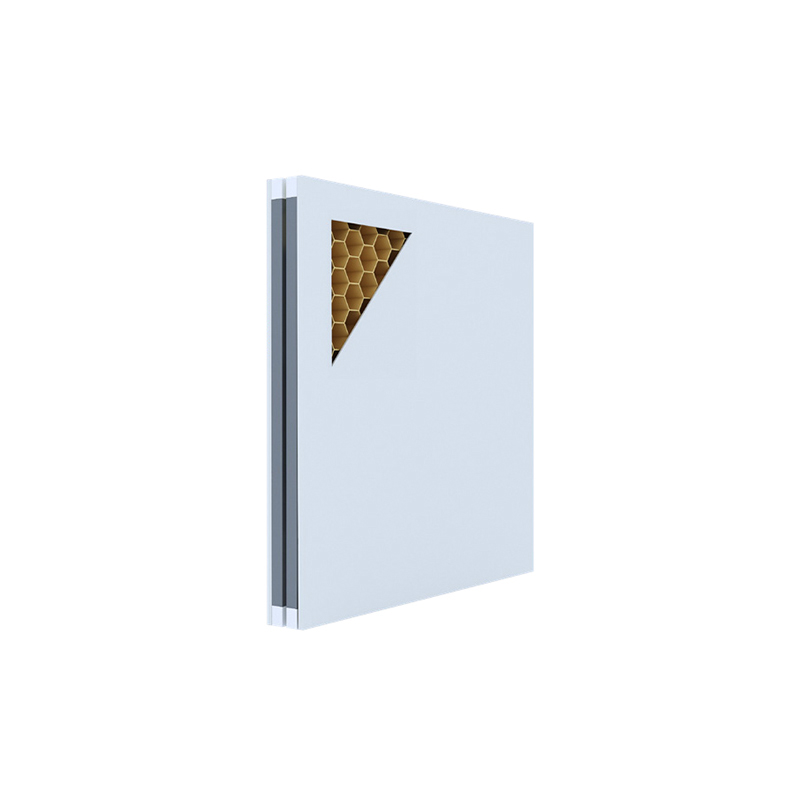
Insulating Paper Honeycomb Sandwich
Superior Hygiene & Cleanliness: Engineered with smooth, non-porous surfaces that effectively resist bacteria, mold, and contaminants, ensuring effortless cleaning and adherence to stringent sanitation standards.
Effective Thermal Insulation & Airtight Sealing: Delivers consistent temperature and humidity control, creating optimal conditions for sensitive operations and maintaining environmental stability.
Fire-Resistant & Durable: Designed with advanced fire-resistant materials, it ensures enhanced safety and long-lasting performance, making it ideal for controlled environments where reliability is critical.
Versatile Applications: Perfectly suited for industries such as pharmaceuticals, healthcare, and electronics, where strict contamination control and fire safety are paramount.
Lightweight & Modular Construction: Facilitates quick installation and offers flexible customization options, allowing it to meet the specific requirements of clean room environments with ease.
Product Introduction
The innovative and eco friendly Paper Honeycomb Sandwich Panel pairs a lightweight paper honeycomb core with tough outer layers, optimizing its strength to weight ratio. Its remarkable thermal insulation curbs heat transfer, promoting energy efficiency in both homes and businesses. This makes it an ideal pick for various construction projects. Additionally, its soundproofing prowess makes it perfect for noise sensitive settings like offices and hotels. The sustainable paper honeycomb structure, being highly durable, ensures great performance across diverse applications, all at an affordable cost.

Product Details
Panel Options: Color-coated panel, galvanized steel sheet, stainless steel sheet
Standard Colors: White gray, crimson, silver, sea blue, and more
Recommended Coatings: PVDF, SMP, HDP, PE
Production Process: Unwinding → Pressing → Laying → Double-track curing and molding → Drying and cooling → Stacking → Packaging

Product Specifications
Effective width | Wall panel: 950mm |
Roof panel: 960mm | |
Material | Color Steel Sheet |
Rockwool board | |
Structure | Upper and lower layer: color steel sheet |
Middle layer: Rockwool board | |
Thickness | Color steel sheet: 0.5~0.8mm |
Rockwool board: 50mm, 75mm, 100,150mm | |
Rockwool Density | 120kg/m³ |
Lifetime | 20~35 years |
Features | Heat Insulation, light weight, quick installation,waterproof, fireproof, soundproof, energy-saving,environmental friendly, |

Insulating paper honeycomb sandwich panels represent a cutting-edge solution in lightweight construction and thermal insulation. Engineered for high strength-to-weight ratios, energy efficiency, and sustainability, these panels are increasingly used in architecture, furniture manufacturing, automotive, and packaging.
This article offers a technical deep dive into the structure, materials, manufacturing process, compliance standards, and key use cases of paper honeycomb sandwich panels, with a special focus on their insulating properties.
Table of Contents
What Is an Insulating Paper Honeycomb Sandwich Panel?
Structural Design and Engineering Principles
Thermal and Mechanical Performance Data
Manufacturing Process Overview
Industry Standards and Environmental Compliance
Common Applications and Use Cases
Installation, Handling, and Safety Guidelines
Frequently Asked Questions (FAQs)
Conclusion and Call to Action
1. What Is an Insulating Paper Honeycomb Sandwich Panel?
An insulating paper honeycomb sandwich panel consists of three main layers:
Outer Facesheets (Skins): Usually kraft paper, aluminum foil, or fiberboard
Core: Honeycomb-shaped kraft paper cells filled with air or insulation material
Adhesive: Environmentally friendly thermosetting glue or PU adhesive
The honeycomb structure mimics the geometry of natural beehives, providing exceptional compressive strength, dimensional stability, and thermal insulation with minimal material use.
2. Structural Design and Engineering Principles
Key Properties:
Sandwich Core Type: Expanded paper honeycomb
Cell Size: 10mm–30mm (hexagonal)
Panel Thickness: 10mm to 100mm
Density: 30–80 kg/m³
Thermal Conductivity (λ): 0.035–0.045 W/m·K
Compressive Strength: 0.5–1.5 MPa depending on core density and facesheet type
🔧 Engineering Principle:
The air-filled cells in the honeycomb structure trap heat and absorb energy, significantly reducing heat transfer and improving sound insulation. The face sheets take on tensile and compressive forces, while the core resists shear deformation—ensuring overall panel rigidity.
3. Thermal and Mechanical Performance Data
| Property | Value | Standard |
|---|---|---|
| Thermal Conductivity (λ) | ≤0.045 W/m·K | ISO 8301 |
| Compressive Strength | ≥0.6 MPa | GB/T 6566 |
| Fire Rating | B2–B1 (depending on adhesive and skins) | DIN 4102 |
| Moisture Resistance | Medium (waxed or laminated surfaces improve performance) | Internal QC |
| Bending Strength | 20–40 N/mm² | EN 310 |
| Sound Absorption | 18–25 dB | ISO 10140 |
4. Manufacturing Process Overview
Step 1: Core Preparation
High-quality kraft paper is slit, printed, and bonded in a zigzag pattern.
The bonded stack is then expanded into a honeycomb core.
Step 2: Adhesion and Lamination
Core is bonded to face sheets (paper, MDF, HDF, aluminum foil) using PU adhesive or hot-melt glue.
A continuous press system ensures uniform bonding and curing.
Step 3: Trimming and Cutting
Panels are cut to size (e.g., 1200mm x 2400mm), optionally CNC-routed for assembly.
Step 4: Quality Inspection
Tests performed for flatness, bonding strength, fire resistance, and dimensional tolerance.
5. Industry Standards and Environmental Compliance
| Standard | Description |
|---|---|
| ISO 16610-21 | Surface profile assessment |
| ISO 8301 | Thermal conductivity of insulating materials |
| DIN 4102 | Fire behavior (B1: hardly flammable) |
| EN 13986 | Wood-based panels for use in construction |
| RoHS / REACH | No heavy metals or harmful substances |
| FSC® Certified Paper | Sustainable forest sourcing |
Most paper honeycomb cores are 100% recyclable, and many manufacturers use formaldehyde-free adhesives.
6. Common Applications and Use Cases
✅ Architectural & Interior Applications
Wall partitions
Ceiling tiles
Door cores
Raised floors
✅ Furniture Manufacturing
Lightweight desks, cabinets, and panels
Hollow core tabletops and shelves
Flat-pack and modular furniture systems
✅ Transport & Automotive
Caravan walls, train interior partitions, truck side panels
Reduces fuel usage by lowering weight
✅ Industrial Packaging
Protective, reusable, and eco-friendly packaging for fragile goods
7. Installation, Handling, and Safety Guidelines
Installation Tips:
Can be mounted with mechanical fasteners, adhesives, or magnetic systems
Ensure surface is dry, clean, and flat
Avoid excessive moisture or direct water contact unless laminated or treated
Handling Notes:
Panels are lightweight yet delicate under point loads—lift using full edge support
Store horizontally in a dry and ventilated area
Safety:
Use dust masks and gloves when cutting
Ensure panels meet fire safety rating for public applications (e.g., B1 DIN 4102)
8. Frequently Asked Questions (FAQs)
Q1: Is paper honeycomb insulation fireproof?
Standard kraft paper cores are not inherently fireproof but can achieve B1 rating with fire-retardant adhesives and surface laminates.
Q2: How strong is a honeycomb panel?
Very strong under distributed loads, but susceptible to point loads or concentrated punctures unless reinforced.
Q3: Can these panels be used outdoors?
Only with UV and moisture-resistant skin layers (e.g., aluminum foil, PVC laminated board). Standard paper faces are for indoor use.
Q4: How does it compare to foam or mineral wool insulation?
Lighter and more eco-friendly than foam
Slightly lower insulation value than mineral wool but better weight/performance ratio
Q5: Are custom sizes and shapes available?
Yes. Panels can be cut, routed, and laminated to fit OEM applications.
9. Conclusion and Call to Action
The insulating paper honeycomb sandwich panel is a versatile, sustainable, and cost-effective solution for multiple industries requiring lightweight yet durable and thermally efficient components. Its unique cellular structure, coupled with recyclable materials and modular adaptability, makes it a strong candidate in today’s low-carbon, high-performance construction and manufacturing sectors.


