


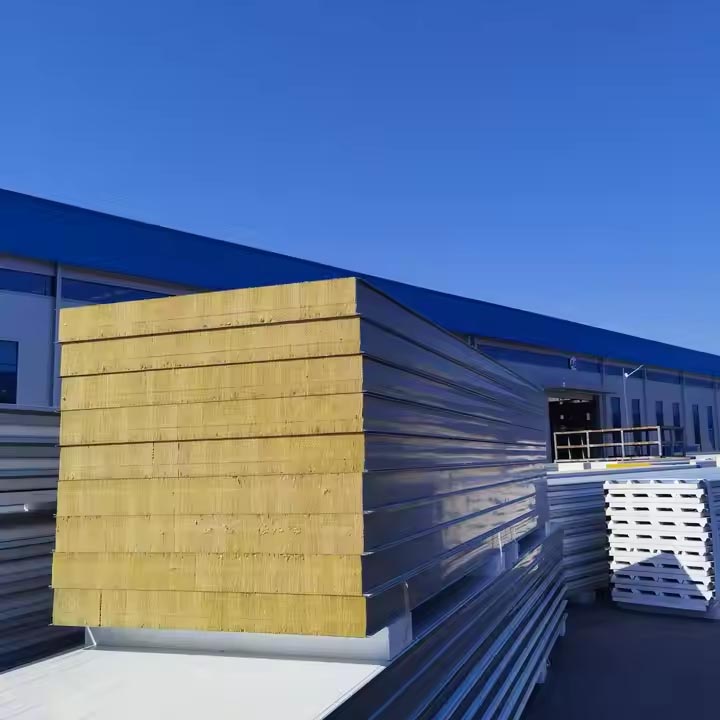


Sandwich Panel Made of Rock Wool
Sandwich panels made of rock wool deliver outstanding fire resistance, thermal insulation, and acoustic control in a lightweight, modular format. Their non-combustible core (Euroclass A1) ensures compliance with strict building codes, while their low thermal conductivity supports energy efficiency. They are durable, moisture-resistant, and recyclable, making them a sustainable solution for modern construction. With proven performance in industrial, commercial, and residential projects, these panels provide cost savings, long service life, and enhanced safety. Their versatility across walls, roofs, and partitions makes them a trusted choice for projects requiring both structural reliability and advanced insulation properties.
A sandwich panel made of rock wool is an advanced construction material designed for fire resistance, thermal insulation, and acoustic performance. These panels consist of two metal facings (commonly galvanized steel or aluminum) with a rock wool insulation core. They are widely used in industrial, commercial, and residential buildings due to their compliance with international safety standards and their long-term durability.
Engineering Principles
Composite Structure:
The metal facings provide load-bearing capacity, impact resistance, and weather protection.
The rock wool core offers low thermal conductivity (0.035–0.045 W/m·K) and excellent fireproofing properties.
Fire Resistance:
Rock wool is classified as non-combustible (Euroclass A1 according to EN 13501-1).
Panels can achieve fire ratings of up to 4 hours (EN 1364-1 test standard) depending on thickness and joint system.
Acoustic Insulation:
Rock wool density (100–150 kg/m³) allows for sound reduction of up to 30–35 dB, making them suitable for noise-sensitive environments.
Industry Standards and Compliance
EN 14509: Self-supporting double-skin metal faced insulating panels.
ASTM E84: Surface burning characteristics of building materials.
FM Approval & UL Certification: Required for international industrial projects.
ISO 9001 & ISO 14001: Quality and environmental management in manufacturing.
Advantages of Rock Wool Sandwich Panels
Non-Combustible: Maintains structural integrity under extreme heat.
Thermal Efficiency: Reduces energy costs in HVAC-intensive buildings.
Moisture Resistance: Hydrophobic fibers prevent water absorption.
Durability: Resistant to mold, rodents, and chemical exposure.
Versatility: Used in facades, partition walls, roofing, and cold storage.
Operational Notes
Ensure proper joint sealing with PU or mineral-based sealants for airtightness.
Panels must be installed with non-thermal bridging fasteners to preserve insulation efficiency.
Regular inspections are necessary in high-humidity areas to avoid corrosion of metal facings.
Comply with local fire codes and load-bearing regulations before installation.
Applications
Industrial Plants: Provides fire-resistant enclosures for machinery and equipment.
Commercial Buildings: Used in shopping malls, office partitions, and warehouses.
Clean Rooms & Cold Storage: Maintains consistent indoor climate.
Residential Projects: Offers safe and quiet living environments.
Frequently Asked Questions
Q1: How long do rock wool sandwich panels last?
With proper installation and maintenance, they can last 25–40 years.
Q2: Are they environmentally sustainable?
Yes, rock wool is made from basalt and recycled slag, both recyclable materials.
Q3: What thickness is recommended?
Panels range from 50 mm to 200 mm, with thicker cores used for fire-rated walls.
Q4: Do they require special handling?
Yes, protective gloves and masks should be worn during cutting or handling to avoid skin irritation.


